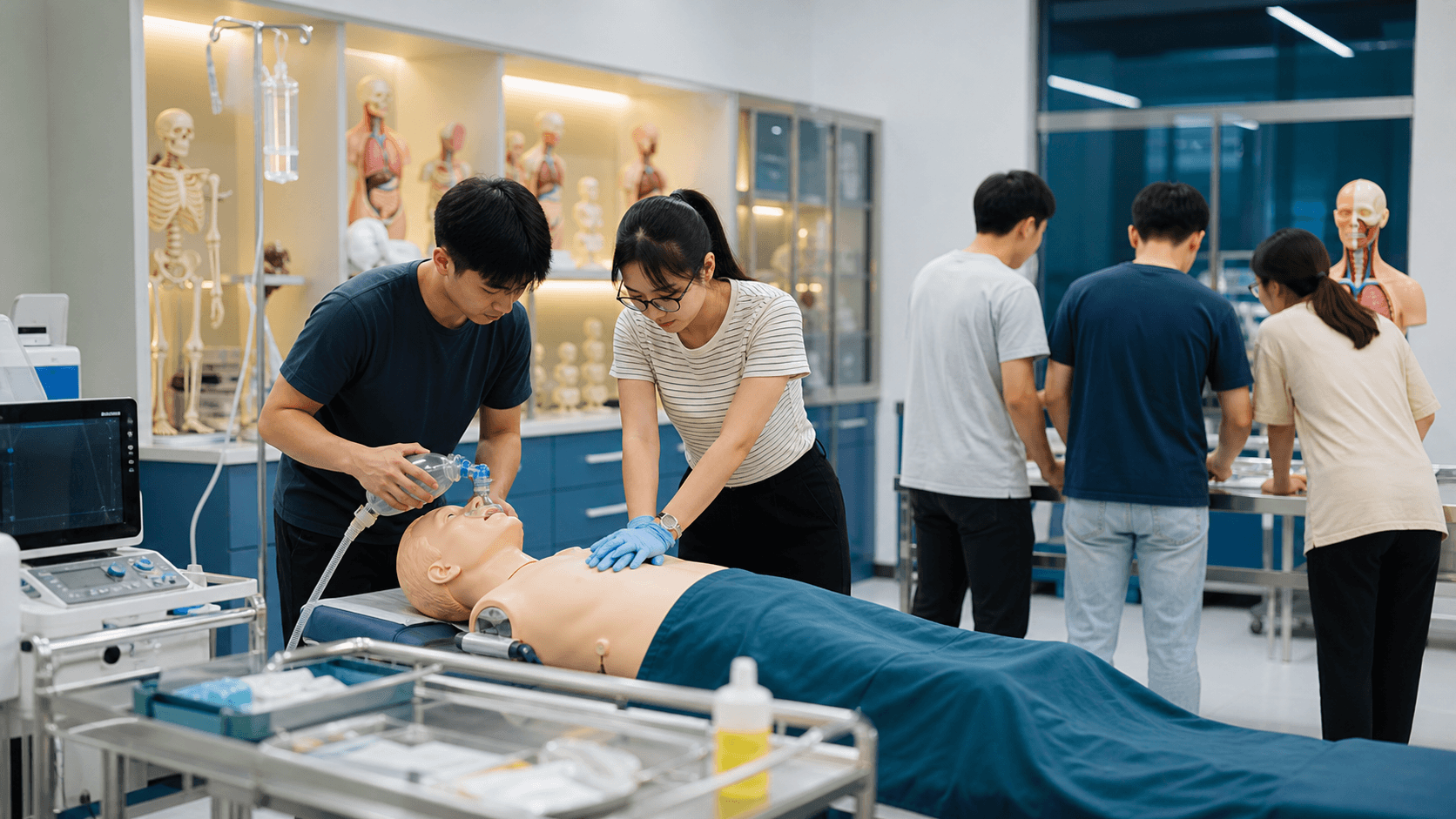
Vietnam MBBS Labs and Simulation: What to Verify
Direct answer: A university’s laboratory or simulation facility can support medical learning, but a photograph of equipment does not prove how often students use it, which subjects it supports, who supervises practice or how it connects to real clinical training. Indian applicants should ask for the current curriculum, practical schedule, assessment method and clinical-rotation plan for the exact programme.
Laboratory and simulation-based learning are valuable because students can practise observation, communication and procedures in a controlled environment before working with patients. They are one part of medical education, not a substitute for supervised hospital exposure, a recognised degree pathway or compliance with India’s licensing requirements.
What should a medical teaching laboratory include?
Look for subject-specific teaching spaces, supervised practical work and a clear link to course outcomes. Depending on the curriculum, students may need access to:
| Area to verify | What it may support | Evidence to request |
|---|---|---|
| Anatomy teaching | Structures, imaging and applied anatomy | Course outline and practical timetable |
| Biochemistry or chemistry | Laboratory methods and interpretation | Equipment list and safety procedure |
| Physiology or biomedicine | Measurement, experiments and basic analysis | Practical outcomes and instructor details |
| Clinical-skills room | Examination, communication and procedural practice | Skills logbook and assessment method |
| Simulation centre | Scenarios, team training and feedback | Student access rules and scenario schedule |
| Clinical partners | Supervised practice with patients | Programme or hospital rotation information |
“State-of-the-art” is not a measurable answer by itself. Ask how many students share a station, whether equipment is available during scheduled practicals, whether consumables are included, and whether the facility is used by the medical programme or mainly for external courses.
What is simulation-based medical education?
Simulation is structured practice using models, task trainers, simulated patients, digital tools or a simulated clinical environment. It can help students repeat a skill, receive feedback and learn teamwork without exposing a real patient to an unready procedure. Simulation may cover basic examination, communication, resuscitation, emergency response, clinical reasoning or procedural steps.
VinUniversity’s College of Health Sciences describes a Medical Simulation Center for professional procedures, communication, ethical and scenario-based training and team training. Its published materials also describe pre-clinical teaching labs, including anatomy models and a digital dissection table. These are official descriptions of VinUniversity’s facilities, not a claim about every university in Vietnam.
What can Indian students learn from a simulation-hospital example?
A detailed facility description is useful only when students connect it to curriculum access and assessment. Phan Chau Trinh University publicly describes a preclinical skills simulation hospital with areas modelled on hospital departments, patient models, standardised patients, diagnostic and procedural spaces, and an OSCE centre. Its international-student materials also describe assessment stations and recorded performance review.
These examples show the questions a student should ask: Is the simulation facility part of the enrolled programme? In which year does access begin? Are sessions compulsory? Are skills recorded in a logbook? Is performance assessed by an OSCE or another method? What happens if a student does not meet a skill standard? A facility list alone cannot answer those questions.
How do labs connect to hospital training?
Laboratory and simulation practice should prepare students for, but not replace, supervised clinical learning. Ask when students enter hospitals, which departments they rotate through, who supervises them, what language support is available and how attendance is recorded. Confirm whether the programme publishes a clinical curriculum and whether the arrangement applies to international students in the same way as local students.
Be careful with claims about hospital size, patient volume, accreditation or guaranteed procedures. A university may have agreements with hospitals without promising every student a particular case, procedure or number of patients. The safer question is what the current programme requires and how the university documents completion.
What questions should parents ask during university selection?
Ask for evidence that is specific to the medical programme and cohort. Use this checklist:
- Which anatomy, physiology, pathology and laboratory practicals are compulsory?
- How many students normally work at one station?
- What equipment or models do students use personally rather than only observe?
- Are practical consumables, protective equipment and repeat practice included in the stated fee?
- Which clinical skills are assessed, and are OSCE or skills-logbook criteria published?
- When does supervised hospital training begin, and which locations are used?
- How are English-speaking international students supported during practical and clinical sessions?
- Can the university show the current curriculum, timetable, handbook or official programme specification?
Request answers from the university’s official admissions or programme office. A campus tour or video can supplement documents, but it should not replace them. If a facility is still proposed or under development, ask for the confirmed opening date and what students will use until then.
Do advanced facilities guarantee better outcomes?
No. Facilities alone do not guarantee academic success, clinical competence, admission, licensing or employment. Student outcomes depend on curriculum, teaching quality, supervision, practice, assessment, attendance, language, personal effort and the applicable regulator’s requirements. Parents should assess the whole programme rather than choosing on the basis of a simulator photograph or a superlative.
For Indian students, also read the current NMC rules and FMGL materials and check the university’s degree, duration, internship and clinical-training details. The site’s internship verification guide, graduation-document checklist and clinical-training overview cover related questions.
Official-channel and fraud warning
No consultancy can guarantee access to a simulator, a hospital case, a pass result, a licence or a job. Verify facilities, curriculum, clinical rotations, fees and refund terms through the university’s official channels. Do not pay for a “premium seat” or private access unless the university issues a written, itemised policy. Never share OTPs or make payments to a personal account without verification. For Aieraa’s official admissions and student-support flow, call +91 93441 41424 or use the official contact page.
For broader selection, compare the university-selection guide, partner university pages and MBBS in Vietnam overview.
FAQs
Are simulation facilities compulsory in every Vietnam MBBS programme?
Not necessarily. The curriculum and university rules determine whether simulation or practical sessions are compulsory.
Does a simulation hospital replace real hospital training?
No. It provides controlled practice; supervised patient-based clinical learning remains a separate programme requirement where applicable.
What is an OSCE?
An Objective Structured Clinical Examination uses stations or scenarios to assess defined clinical skills and communication. The exact format varies by programme.
Should parents trust facility photographs?
Use photographs as a starting point, then verify curriculum access, student numbers, timetable, supervision and assessment in writing.
Are international students guaranteed the same lab access?
Do not assume so. Ask the university to confirm access and practical requirements for the international medical programme.
Can advanced equipment prove NMC compliance?
No. Equipment is only one part of programme evaluation. Check current NMC requirements and the university’s full degree and clinical-training pathway.
Source and limitation note
Verified on 26 July 2026 against VinUniversity College of Health Sciences’ Teaching Labs for Preclinical Sciences and Medical Simulation Center pages, and Phan Chau Trinh University’s official preclinical simulation-hospital description and international-student OSCE report. Facilities, equipment, student access, clinical placements, curricula and regulator requirements can change; obtain current written confirmation from the intended university.
Written by Aieraa Overseas Editorial Team
Reviewed by Mr. Vijaya Raghavan (Raghu), Director of Admissions