Vietnam MBBS Hostel Fire Safety: Evacuation Checklist
Direct answer: Before moving into a Vietnam MBBS hostel or private rental, confirm the building’s emergency exits, alarm arrangements, evacuation plan, assembly point, electrical rules and after-hours contacts. A clean room or convenient location is not evidence that the accommodation is prepared for a fire. Ask the university or accommodation operator for current written instructions and walk the route yourself on arrival.
Vietnam’s fire-prevention and rescue law places fire safety within the responsibility of organisations, households and individuals, and requires preparedness, local response arrangements and compliance with applicable standards. A university residential guideline can add practical details such as drills and a facility-specific evacuation plan, but one campus policy cannot be assumed to apply to every hostel or rented room. Use this guide alongside our student housing rental checklist, parent safety guide and emergency contacts checklist.
What to verify before accepting a room
Request the building-level safety information before paying a deposit. The most useful evidence is not a marketing photograph; it is a current plan and a person who can explain what students should do. Ask for:
| Area | Questions to ask |
|---|---|
| Exits | How many usable escape routes serve the room and floor, and are they unlocked and unobstructed? |
| Alarm | What sounds or signals indicate an emergency, and who tests the system? |
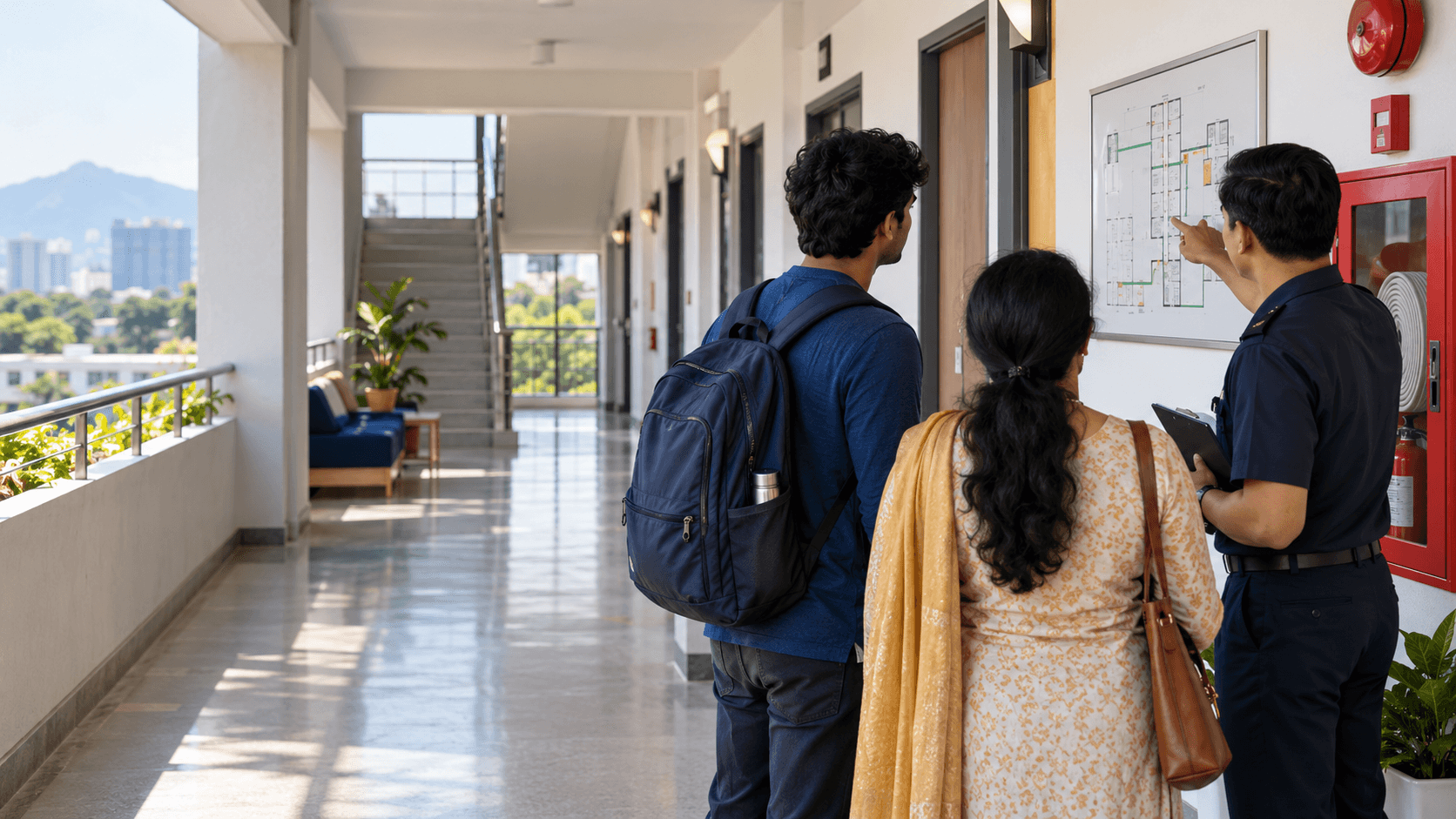
| Plan | Where is the posted evacuation map, assembly point and accessible route? |
| Equipment | Where are extinguishers, hose reels, first-aid supplies and emergency lighting located? |
| Contacts | Who answers at night, and which university, residence and local emergency numbers should be called? |
| Practice | When was the last drill, and how are new international students briefed? |
If staff cannot answer basic questions or ask students to ignore alarms, treat that as a serious due-diligence concern. Do not rely on a verbal assurance that “the building is safe”; ask who is responsible for maintenance and how faults are reported.
How to inspect the route on arrival
Walk from your room to the outside assembly point in daylight and, if permitted, review the route for night-time conditions. Note the nearest stairwell, a second route, emergency lighting, door direction, floor number and any gate or security desk that could delay exit. Keep the corridor, landing and stair door clear. Do not wedge a fire door open or store shoes, cartons, bicycles, cooking appliances or luggage in an escape path.
Check whether the map is for the actual building and floor. A generic diagram in a reception area may not show a later room change, a locked service door or a different block. Ask how students who cannot use stairs are assisted. The answer should come from the residence or university’s own procedure, not from another student’s guess.
Electrical and cooking checks for Indian students
Electrical overloading and informal cooking arrangements deserve specific questions. Confirm whether induction cookers, rice cookers, kettles, extension boards and chargers are allowed in the room or only in a designated kitchen. Use equipment in good condition and follow the residence’s wattage and socket rules. Do not daisy-chain extension boards, cover a charger with bedding, leave cooking unattended or bring an appliance that the hostel prohibits.
Ask who repairs damaged sockets, fans, air-conditioners and power strips, and how quickly a student should report heat, sparks, burning smell or repeated tripping. Do not attempt electrical repairs yourself. Photographing a fault for the maintenance channel may help, but do not touch exposed wiring or continue using equipment that appears unsafe.
What students should do during an alarm
Follow the building’s written evacuation procedure, leave promptly, and do not return for belongings. If there is smoke or a fire, alert nearby people without putting yourself in danger, activate the alarm if the procedure says to do so, and call the local emergency service or residence contact. Use the nearest safe exit; do not use a lift unless an authorised emergency procedure specifically permits it. Close doors behind you if that can be done safely, move to the designated assembly point and tell staff if someone may still be inside.
This article is not a substitute for local emergency instructions or professional training. Never enter smoke, fight a fire beyond your training, or delay evacuation to collect a passport, laptop or medicine. If a student has a disability, injury or other support need, agree the assistance plan with the residence before an emergency.
Questions parents should put in writing
Parents should ask for the same information the student receives. Request the residence name and address, room block and floor, emergency numbers, rules for cooking and appliances, visitor policy, drill frequency, maintenance reporting channel, night supervisor and process for moving rooms when a hazard is reported. Confirm whether the accommodation is university-managed, university-approved or independently rented. Those labels describe different levels of responsibility.
Keep the signed agreement, fee receipt, safety instructions and messages about reported faults. If the accommodation provider refuses to identify an emergency contact or will not explain the exit route, pause before payment and seek written clarification through the university or a competent local authority.
Official-channel and fraud warning
No consultancy can guarantee admission, a visa, a refund, an academic result, a clinical placement or an Indian licence. Verify university, immigration and payment details through official channels. Do not pay a personal account, share OTPs, or hand over an original passport to an unverified intermediary. For Aieraa’s official support, call +91 93441 41424 or use the official contact page.
Frequently asked questions
Is a university hostel automatically fire-safe?
No. A university name does not replace a building-specific inspection. Ask for the actual plan, exits, alarms, drills and responsible contact for the residence where the student will live.
What should I check first in a rented room?
Identify two escape routes if available, the assembly point, alarm method, building contact and any locked gate or stair door. Then check electrical and cooking rules.
Can I use a rice cooker in my hostel room?
Only if the residence’s current written rules allow it and the equipment is used safely. Many residences restrict cooking appliances to designated areas, so do not assume permission.
Should students use a lift during a fire?
Normally students should use the safe evacuation route specified by the building and avoid lifts during a fire. Follow the residence’s emergency procedure and directions from trained responders.
What if the fire alarm is a false alarm?
Evacuate according to the procedure unless authorised staff clearly cancel it. Students should never decide that an alarm is harmless before checking with the responsible safety team.
Can Aieraa certify a hostel’s safety?
No. Aieraa can help a family ask the university or accommodation provider for current information, but the building owner, university and competent local authorities control safety compliance.
Verified on 13 October 2026 against Vietnam’s Law on Fire Prevention, Firefighting and Rescue No. 55/2024/QH15, VinUniversity’s current Residential Life Guideline, the university’s public student-affairs policy index and the site’s current housing and emergency guides. Fire systems, drills, staffing, building approvals, local emergency numbers and residence rules vary by property, city, university and date; obtain current written instructions before moving in.
Written by Aieraa Overseas Editorial Team
Reviewed by Mr. Vijaya Raghavan (Raghu), Director of Admissions