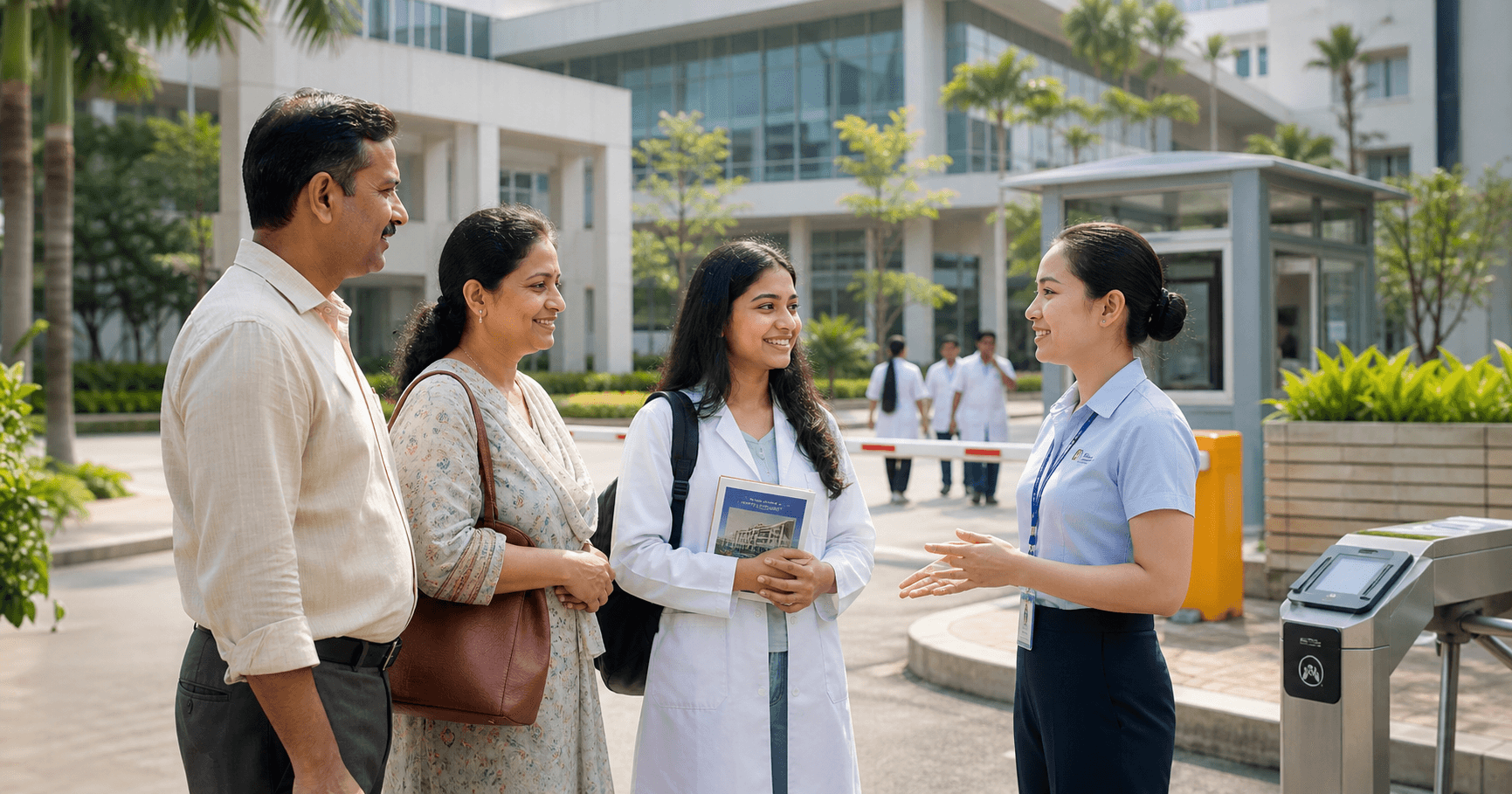
If you're a parent reading this, you've probably already been through the fee tables, the NMC compliance checklists, and the university rankings. But there's one question that actually keeps most parents up at night, and it rarely gets a straight answer: is it actually safe to send my child — especially my daughter — to live alone in Vietnam for six years?
This isn't a marketing page dressed up as reassurance. It's a direct answer, with real numbers, to the specific worries parents raise with our counsellors every week: street safety, hostel security, food and health, staying in touch, and what happens in a genuine emergency.
Let's Start With the Actual Numbers
Vietnam's global peace and crime-safety indices consistently rank it among the safer countries in Asia for foreign residents — safer, on independent safety-rating comparisons, than Russia and significantly safer than Kyrgyzstan, two of the other major MBBS-abroad destinations Indian families consider. Violent crime against foreigners is rare and typically makes national news precisely because it's unusual, not routine.
Da Nang specifically — where three of Aieraa's seven partner universities are based (PCTU, Dong A, and easy access from Can Tho) — is consistently rated Vietnam's safest, cleanest city. Low crime rates, well-lit streets, a genuinely friendly local population, and a police presence that's visible without being intrusive. Parents who visit during orientation or graduation consistently tell us it feels safer than many Indian cities they know well.
What About Specifically for Female Students?
This is the question we get most often, and it deserves a direct answer rather than a deflection. Vietnamese culture has a strong general respect for personal space and public order — harassment of the kind reported in some other study-abroad destinations is not a common pattern in Vietnam's university cities. That said, "generally safe" is not the same as "no precautions needed," and here's what's actually in place:
- Separate hostels for girls and boys at every Aieraa partner university — not shared floors, fully separate buildings or wings
- 24/7 Indian hostel in-charge on-site — not a distant helpline, an actual person physically present who speaks Hindi/English and can respond immediately
- CCTV coverage across common areas and entrances at every Aieraa-managed hostel
- Curfew and visitor policies consistent with what most Indian parents expect from a hostel environment back home
- A genuine, growing community of Indian female students at every partner university, so no one is navigating this alone as the "only" Indian student on campus
We've placed hundreds of female students across our partner universities since 2021, and the pattern our counsellors see repeatedly is the same: real anxiety before departure, and a call home within the first month saying "it's actually fine, Mom" — because the infrastructure genuinely holds up once they're there.
Food and Health — The Second Biggest Worry
After safety, food is the next thing every parent asks about, usually phrased as "will they even eat properly?" Here's the honest picture:
- Aieraa Hospitality runs dedicated Indian messes at every partner university hostel — North Indian, South Indian, and Andhra menus, both vegetarian and non-vegetarian, with Halal options
- Students can change their menu preference through an online hostel portal — this isn't a fixed one-size-fits-all canteen
- Festivals (Diwali, Pongal, Eid, Christmas) are actively celebrated with special meals — students have told us this matters more emotionally than practically, and we take it seriously for exactly that reason
- For medical care, all Aieraa partner universities either run their own teaching hospital on-campus or have direct affiliations with major city hospitals — meaning a medical emergency doesn't mean scrambling to find unfamiliar healthcare in a foreign country. Your child is training inside the same hospital system that would treat them.
Staying in Touch: What Communication Actually Looks Like
Vietnam has excellent, affordable internet infrastructure — video calls home are a daily-life norm for students, not a scheduled weekly event. WiFi is standard in every Aieraa hostel, and most students are reachable on WhatsApp exactly as they would be if they were studying in another Indian city. The time difference from India is only 30 minutes, so there's no jet-lag-style disconnect in daily routines — dinner time in Vietnam is roughly dinner time in India.
What Happens in a Genuine Emergency?
This is the scenario every parent silently worries about, so let's be specific rather than vague:
- Medical emergency: Students are already living adjacent to (often literally on the campus of) a teaching hospital. Aieraa's local in-charge coordinates immediately and informs the family the same day.
- Family emergency back home: Aieraa assists with emergency leave documentation and travel booking — this isn't left for the student to figure out alone at 2am.
- Any safety incident: The Aieraa in-charge is the first point of contact, available 24/7, with escalation to campus security and local authorities as needed. Vietnam's local police response for foreign students is generally prompt and taken seriously — a foreign-student safety incident draws swift institutional attention precisely because it's uncommon.
A Note on Why This Matters to Us Specifically
Aieraa doesn't just process an application and disappear once your child boards the flight. We run the hostels. We staff the in-charges. Our reputation with every partner university depends on students actually thriving, not just arriving — because a bad outcome for one student damages every future placement we make. That alignment of incentives is, practically speaking, the reason the infrastructure above exists and gets maintained, not just advertised.
Frequently Asked Questions
Is Vietnam safe for a girl studying alone, away from family?
Yes, based on independent safety rankings and our own placement history since 2021. Separate secured hostels, 24/7 Indian in-charge supervision, and a growing community of Indian female students mean no one is navigating this without support structure in place.
How quickly can my child come home in an emergency?
Flight times from Vietnam to major Indian cities are 4–6 hours, often with direct or one-stop connections. Aieraa assists with emergency travel booking and documentation so this isn't something the student has to arrange alone under stress.
Will my child get proper Indian food?
Yes — dedicated Indian messes with regional menu options (North Indian, South Indian, Andhra, Halal) run at every partner university hostel, with the ability to change menu preferences through an online portal.
What if there's a medical emergency?
All partner universities have on-campus teaching hospitals or direct hospital affiliations. Students are, quite literally, training and living next to the healthcare system that would treat them in an emergency.
How often can we video call?
As often as any family calling within India — WiFi is standard, the time difference is only 30 minutes, and most students are on WhatsApp daily.
Is Da Nang actually safer than other Vietnamese cities?
Yes — Da Nang consistently ranks as Vietnam's safest and cleanest major city, which is why three of Aieraa's seven partner universities are based there or nearby.
What if we want to visit during the course?
Many parents do — flights and short-stay visas for Indian visitors to Vietnam are straightforward, and Aieraa can help coordinate a campus visit or orientation-day attendance.
Important: Only Trust Authorised Admissions — A Note from Aieraa Overseas Studies
Aieraa Overseas Studies is the pioneer and official admission partner for Vietnam's NMC-approved medical universities, with direct MoUs across all 7 partner institutions. We have successfully placed over 1,000 Indian students, and every admission — and every hostel — is handled directly by our team.
Beware of unauthorised agents and consultancies claiming to have partnered with Aieraa or offering admissions to our partner universities. These agents are not authorised by Aieraa and have no official standing with our partner universities.
Do not make any payments to any individual or agency without first verifying their authorisation with us directly. Always call us at +91 93441 41424 before making any payment — no matter how small.
Your child's safety and medical career are both too important to risk on an unauthorised admission. Trust only Aieraa Overseas Studies.
Have More Questions? Talk to Us Directly — Parents Welcome
📞 Call / WhatsApp: +91 93441 41424
📧 Email: info@aieraa.com
Aieraa Overseas Studies — Pioneer. Official Admission Partner. Trusted by 1,000+ Students.