Vietnam MBBS Laboratory Safety: Student Checklist
Direct answer: Before an MBBS practical in Vietnam, a student should know the laboratory’s entry rules, complete any required safety training, wear the specified protective equipment, understand the equipment and chemicals being used, and know exactly how to report a spill, injury, exposure or damaged instrument. Never begin an experiment because another student says it is routine. The instructor, laboratory technician and current university policy control the safe procedure.
Laboratory safety matters across anatomy, biochemistry, microbiology, pathology, physiology, simulation and research. VinUniversity’s teaching-laboratory regulations apply to students and other lab users and require safety training before relevant experiments, appropriate attire and PPE, equipment checks, and immediate reporting of accidents or risks. Its 2025 laboratory-management guideline also assigns responsibilities to supervisors and students. These documents are useful examples of the questions to ask; they are not a universal rulebook for every Vietnamese medical university.
What should students complete before entering a lab?
Complete induction and read the room-specific rules before handling anything. Ask whether the university requires an online module, in-person briefing, quiz, signed form or substance-hazard assessment. VinUniversity’s published guidance refers to laboratory-safety training and, when requested, a Control of Substances Hazardous to Health form before experiments. Other institutions may use different names or procedures.
| Pre-lab check | Question to ask | Why it matters |
|---|---|---|
| Training | Have I completed the required induction for this lab? | Access or practical participation may depend on it. |
| Procedure | Have I read the experiment and hazard instructions? | Unexpected reactions and equipment misuse create avoidable risk. |
| PPE | What protection is required and who supplies it? | Coat, eyewear, gloves, mask and footwear requirements differ. |
| Equipment | Who demonstrates the instrument and records its use? | Students should not guess or repair equipment. |
| Emergency route | Where are exits, eyewash, first aid and spill resources? | Knowing the route saves time during an incident. |
What PPE and clothing are normally important?
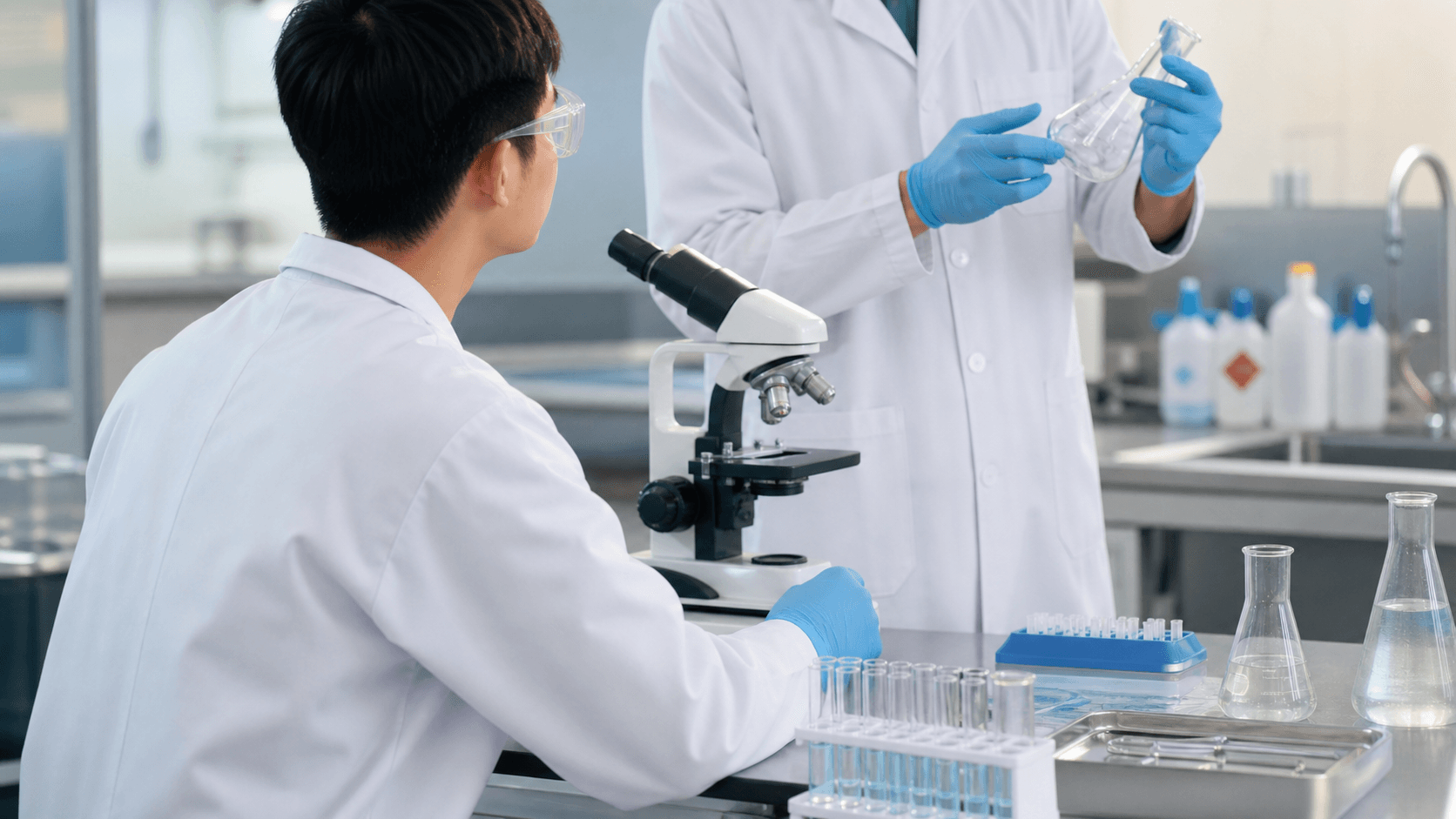
Wear the PPE specified for the task, not simply the equipment that looks professional. Depending on the practical, this may include a fastened lab coat, protective eyewear, suitable gloves, a mask, covered legs and closed shoes. Tie back long hair, secure loose clothing and remove dangling jewellery. Do not use damaged gloves or eyewear, and do not assume disposable gloves protect against every chemical or biological hazard.
Keep clinical and laboratory clothing separate from food, accommodation and leisure items. Ask whether coats remain in the laboratory and where used PPE is discarded. Do not wear practical uniforms outside permitted areas if the university or hospital prohibits it. For anatomy or clinical laboratories, follow the department’s rules for specimens, sharps, ventilation, hand hygiene and waste segregation.
How should students use laboratory equipment?
Use equipment only after the instructor or technician has explained the correct procedure. Check that cables, plugs, guards, glassware, rotors, lids, lenses and other safety features are intact. VinUniversity’s guidance says students should check equipment conditions, stop using defective equipment, notify teaching staff and not repair it arbitrarily. Record equipment use where the lab requires a log sheet.
Use the correct container, volume, temperature and speed for the procedure. Label samples as instructed, keep benches organised and return tools to the designated place. Never move chemicals, specimens or equipment outside the lab without permission. If a microscope, centrifuge, burner, analyser or simulator behaves unexpectedly, switch it off only if the procedure permits and call the responsible staff member.
Never work alone where the policy requires supervision. Do not substitute an online video, an older batch’s notes or a friend’s memory for the current demonstration. A procedure may change after an equipment upgrade, a new reagent or a revised safety review.
What should happen after a spill, exposure or injury?
Stop, alert the responsible person and follow the laboratory’s incident procedure immediately. Move away from danger, warn nearby people and use the emergency equipment only as trained. Do not hide a spill to avoid losing marks. Do not touch a chemical or specimen with bare hands, and do not improvise neutralisation, cleanup or disposal. The supervisor or technician should direct the response.
For a splash, cut, inhalation, burn, needle-stick or other exposure, seek first aid and medical assessment through the university’s official route. Tell the staff member what happened, what material was involved and what PPE was being used. Preserve the relevant label or sample information if it is safe and permitted. Report damaged equipment, near misses and unsafe conditions even when nobody is injured; the purpose is prevention, not blame.
Keep a record of the date, location, activity, supervisor and official report number where provided. Do not post images of an incident or another person online. Student health, patient material and research data may be confidential.
How do anatomy, microbiology and research labs differ?
The hazard changes with the activity, so one generic safety checklist is not enough. Anatomy sessions may involve preservation chemicals, sharps, specimens and strict respect for human material. Microbiology may require biological-containment instructions, disinfection and waste segregation. Chemistry and biochemistry may involve corrosive, flammable or reactive substances. Research labs can add data, sample-ownership, authorisation and equipment-booking rules.
Ask who may access the room, whether photography is prohibited, how specimens are identified, what waste stream applies, and whether a supervisor must approve deviations. Clinical training also adds patient safety and confidentiality. A student must never use a patient sample, clinical record or research material for an assignment or social-media post without the required authorisation and de-identification.
What should parents verify about a university laboratory?
Ask for evidence of a safe process, not just photographs of modern equipment. Before enrolment, request the programme’s practical schedule, laboratory access rules, safety-induction process, PPE arrangements, supervision model, emergency contact route and policy for injuries or exposures. Ask whether students receive written instructions in a language they can understand and how questions are handled.
Equipment lists can change and a good facility does not prove that every class uses every instrument. Likewise, a university’s safety policy does not prove that an affiliated hospital or external clinical site follows identical procedures. The student should obtain the current rules for the actual department and host organisation.
Laboratory-safety checklist for Indian MBBS students
- Complete the current lab induction and any required safety assessment.
- Read the experiment, hazard and waste instructions before starting.
- Wear the specified coat, eyewear, gloves, mask and closed footwear.
- Know the exits, eyewash, first-aid route, spill resources and emergency contacts.
- Check equipment before use and report defects immediately.
- Do not repair, move or modify equipment, chemicals or specimens without permission.
- Keep labels, samples, benches and records organised.
- Never eat, drink, use a phone carelessly or work unsupervised where prohibited.
- Report spills, exposures, injuries, near misses and damaged equipment promptly.
- Keep patient, specimen, research and university information confidential.
Use this with the site’s labs and simulation guide, academic-integrity checklist, patient-confidentiality guide, clinical health-screening guide and MBBS in Vietnam overview.
Official-channel and fraud warning
No consultancy can guarantee admission, a visa, a scholarship, a refund, an academic outcome or an Indian licence. Verify university instructions, payments and student rules through official channels. Do not pay a personal account, share OTPs or hand over an original passport to an unverified intermediary. For Aieraa’s official admissions and student-support flow, call +91 93441 41424 or use the official contact page.
FAQs
Do MBBS students need laboratory-safety training?
Many universities require induction or training before practical work, but the exact process varies. Confirm the target university’s current rule.
Can I use a lab without a teacher present?
Only where the university expressly permits it and the required supervision and access conditions are met. Do not enter restricted areas or work alone by assumption.
What should I do if a reagent spills?
Stop the activity, warn others and contact the instructor or laboratory technician immediately. Follow the official spill procedure; do not improvise cleanup.
Can students take photos in a medical laboratory?
Not automatically. Photography may be restricted by safety, privacy, research, specimen or hospital rules. Ask before taking any image.
Who pays if equipment is damaged?
Do not assume the outcome. Report the problem immediately and follow the university’s equipment and student-conduct process. Never hide damage.
Does a modern lab prove that the programme meets NMC requirements?
No. Facilities and Indian licensing eligibility are separate checks. Verify the exact programme against current NMC requirements and the university’s official documents.
Source and limitation note
Verified on 22 August 2026 against VinUniversity CHS Teaching Laboratories Usage Regulations, VinUniversity Regulations on Management of Laboratories, the VinUniversity dangerous-chemicals safety reference, the World Directory of Medical Schools and the NMC rules index. These sources establish published examples of laboratory governance and due diligence; they do not establish identical procedures or NMC eligibility for every university. Training, PPE, supervision, equipment, waste, incident reporting and clinical-site rules may change.
Written by Aieraa Overseas Editorial Team
Reviewed by Mr. Vijaya Raghavan (Raghu), Director of Admissions