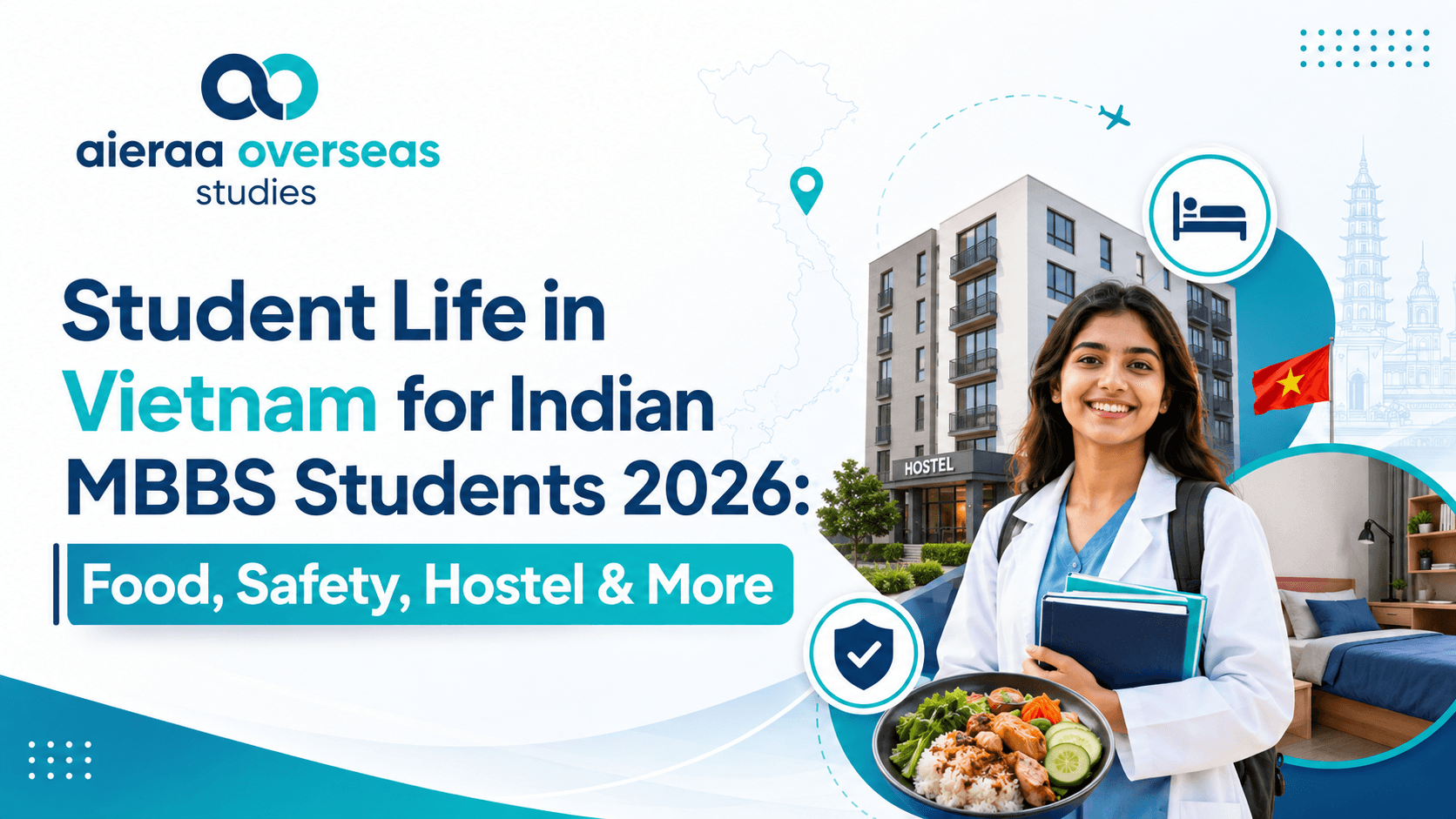
One of the biggest concerns Indian families have before sending their child to Vietnam is not the degree — it's the daily life. What do students eat? Is it safe? Can they make friends? Will they miss home too much? After placing 500+ students across Vietnam since 2021, here's what Aieraa Overseas students actually experience.
⚠️ Official Notice from Aieraa Overseas: Aieraa Overseas Studies is the pioneer and official admission partner for Vietnam's NMC-approved medical universities. Beware of agents falsely claiming to be "Aieraa partners." Do not make any payments without calling us first at +91 93441 41424.
1. Food: Indian Meals Every Single Day
Food is the number one concern for Indian families — and rightfully so. The good news: all four of Aieraa's partner universities have dedicated Indian mess facilities managed or supervised by our team. Students are not forced to eat Vietnamese food if they don't want to.
| University | Indian Mess | Meal Options | Monthly Cost |
|---|---|---|---|
| Buon Ma Thuot Medical University (BMTU) | Yes — on-campus Indian mess | Veg + Non-veg, North & South Indian | ₹7,000–₹9,000 |
| Dong A University, Da Nang | Yes — Indian cook on premises | Veg + Non-veg, roti, sabzi, rice, dal | ₹8,000–₹10,000 |
| Dai Nam University, Hanoi | Yes — Indian caterer | Full Indian menu, weekly specials | ₹8,000–₹11,000 |
| Mekong University (Cuu Long), Vinh Long | Yes — Aieraa-arranged Indian cook | South Indian + North Indian options | ₹7,000–₹9,000 |
Beyond the mess, Vietnamese cities have Indian restaurants — Da Nang and Ho Chi Minh City have the largest concentrations. Indian grocery stores stock masalas, dal, rice, atta, and other essentials. Students who love to cook can easily find everything they need.
2. Safety: Vietnam Is One of Asia's Safest Countries
Vietnam consistently ranks among the safest countries in Southeast Asia for crime. The Global Peace Index places Vietnam in the top 50 globally — safer than many European countries. For students, this translates to:
- Low street crime even late at night
- Very low incidence of theft, scams targeted at foreigners
- Friendly, non-confrontational local population
- Strong police presence in university towns
Aieraa adds an extra layer of safety: all partner university hostels have 24/7 CCTV, security guards, and a strict sign-in/sign-out system. Our local team representative visits regularly and is available on WhatsApp round the clock.
For girl students specifically: Da Nang (Dong A University) is particularly highly rated by female Indian students. It's a clean, well-lit, tourist-friendly city where solo travel after dark is common. Multiple Aieraa girl students have explicitly said they feel safer in Da Nang than in many Indian cities.
3. Hostel Life: What to Expect
| Feature | What Students Get |
|---|---|
| Room type | Double or triple sharing (single available at extra cost) |
| AC / Heating | AC in all rooms (Vietnam is tropical; heating not required) |
| Internet | High-speed Wi-Fi in rooms and common areas |
| Laundry | Washing machines on each floor; some hostels include laundry service |
| Common rooms | TV lounge, study rooms, recreation area |
| Power supply | Stable 220V; bring a multi-plug adaptor for Indian devices |
| Indian community | Separate wings for Indian students on request at partner universities |
4. Weather and Climate
Vietnam has a tropical climate that Indian students adapt to very quickly — it's not very different from South India or Northeast India. Here's a rough guide:
| City / University | Climate | Temperature Range | What to Pack |
|---|---|---|---|
| Da Nang (Dong A) | Coastal, tropical | 20–35°C year-round | Light clothes, raincoat for monsoon (Oct–Jan) |
| Buon Ma Thuot (BMTU) | Highland, cooler | 15–28°C | A light jacket for evenings |
| Hanoi (Dai Nam) | Subtropical, 4 seasons | 10–38°C | Winter jacket (Dec–Feb), summer clothes |
| Can Tho (Mekong) | Hot, tropical delta | 24–35°C | Light cotton, umbrella |
5. Getting Around: Transport and Travel
Vietnamese cities are very motorbike-friendly and increasingly have ride-hailing apps. Indian students use:
- Grab (like Ola/Uber) — available in all major cities, very affordable
- Rented bicycles/scooters — popular among students for daily commute (international driving license needed for scooters)
- Walking — Da Nang and Buon Ma Thuot are compact cities where the university, hostel, and market are within walking distance
Flights home: Vietnam Airlines, IndiGo, and Air India operate routes between Vietnam and major Indian cities. Return tickets typically cost ₹25,000–₹45,000. Students usually go home once or twice a year (semester breaks).
6. Social Life and Making Friends
The Indian student community in Vietnam is tight-knit and growing. Aieraa students benefit from:
- Senior-junior mentoring — before you arrive, Aieraa connects you with current students via WhatsApp
- Batch WhatsApp groups — university-specific + Aieraa-wide groups for support and socialising
- Festivals and celebrations — Diwali, Holi, and Independence Day are celebrated in most universities by the Indian student community
- Cricket and sports — Indian students have informal cricket and badminton groups at most universities
7. Language: Do You Need Vietnamese?
In the first two years, most teaching is in English. From Year 3 onwards, clinical teaching transitions to Vietnamese — but universities provide translators and English-speaking faculty support. Most Aieraa students also take the Vietnamese language course in Year 1, which helps enormously in clinical years and in daily life.
In cities, younger Vietnamese — especially university students and tourist-area staff — speak decent English. In smaller towns and hospitals, basic Vietnamese phrases go a long way.
8. Banking and Money
- Open a local Vietnamese bank account (VPBank or Techcombank recommended for international students)
- Indian students use Niyo Global or HDFC Forex cards for daily expenses
- SWIFT transfers from Indian banks to Vietnamese accounts work smoothly
- Monthly expenses (food, transport, personal): ₹10,000–₹18,000 per month depending on lifestyle
9. Healthcare for Indian Students
Students studying at medical universities have a unique advantage — they are literally on or near a hospital campus. Minor illnesses are handled quickly. Aieraa also arranges health insurance for all placed students covering hospitalisation and emergency medical care in Vietnam.
Start Your MBBS Journey with India's Most Trusted Vietnam Partner
Aieraa Overseas — pioneer & official admission partner. 500+ students placed since 2021.
📞 +91 93441 41424 | WhatsApp: wa.me/919344141424 | Email: info@aieraa.com